Cooperation With The City And Community
The Bedford Garden Club has remained true to its by-laws over the years. Its association with the city of Bedford on projects began early. Over the years the Club has supplied ideas, technical information, volunteer labor, and funding.
In 1936, the city of Bedford was asked to draft a resolution requiring all cats in town to wear a bell! The next year the Club requested that all dogs be kept tied at home. Township records at the time indicate that roaming dogs were a real problem. The newspaper makes mention of a child who lost a foot in a mowing accident as he tried to avoid a dog who had bitten him earlier. Police records list several times when an officer was called out to “shoot a dog” who was roaming. The Garden Club’s request to eliminate this overzealous resolution to the problem, resulted in the City’s leash law.
Through the Club’s petitioning, the City adopted the Azaleamum as the town flower in 1940, a true pink, multi-petaled cushion chrysanthemum. Reaching back from the past, Bedford Square will again be graced with the town flower. Three hundred cushion mums are scheduled for planting in August, 2002, by the Bedford Garden Club. Again, this event to commemorate our 75th Anniversary.
The practice of dumping trash in a homeowner’s backyard or a city dump was identified. The Club urged the City to enact laws to eliminate this and provide refuse pick-up. A Weed Control committee, chaired by Mrs. Edna Handyside, pressed City Manager Arthur Wedge, the first city manager, to mow vacant lots and cleanup weed-infested areas. Home owners were encouraged to beautify front yards. Real estate agents were asked to mow weeds on “for-sale” property.
Flowering crabapple trees were planted April, 1941, under the Broad Street overpass (Northfield Road bridge). The Square was targeted for beautification. For sixty-five years planting trees, shrubs, and flowers on Bedford Square was a continuing project, often requested by the city managers. In Bedford Cemetery, hydrangea trees, flowering crabapples, holly trees, the design and planting of choice shrubs for the Babyland Section (180 daffodil bulbs added in 2001), and the 2002 Arbor Day tree planting in the veterans’ area
Babyland section in Bedford Cemetery established in the 1900’s are a living legacy.
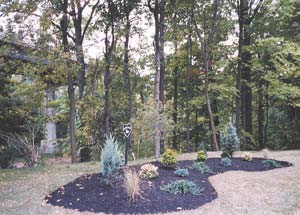
Babyland section in Bedford Cemetery established in the 1900’s
So, too, are the dogwoods in the Glens, the YMCA building on Tarbell, the Bedford Library, the Bedford Municipal Hospital grounds and the nurses’ residence across the street from the hospital on Blaine Street. Early minutes of meetings indicate a desire to make the nurses’ residence a pleasant place to live. The Club planted trees and flowers on the outside. Also, a live decorated Christmas tree was provided at the holiday. One year the wreath the Club constructed for the home was so beautiful, that Miss Cline, the hospital director, requested that it be placed in the hospital lobby.
During World War II, victory gardens dotted the landscape of America. Vacant land was cleared for citizens to plant their own garden plots. With rationing in place, this allowed people to enjoy fresh fruits and vegetables gleaned from their personal efforts. In May 1941, City Manager Arthur Wedge was approached by Club members at the behest of the late Clyde Steele about using vacant lots for community gardens. These victory gardens in Bedford were located on the east side of Center Road where St. Pius church and school now stand. Club member, Arlene Fuhrmeyer offered the use of water from her home across the street; a hose was stretched across Center Road to accomplish the task. The gardens were so successful that in May, 1943, more garden plots became available around the City. With the end of World War II and the birth of the “supermarket,” most victory gardens were discontinued, leaving just a memory.
As a continuing war effort, Mrs. Handyside initiated a program of sending seeds to the “starving” people of Europe to plant their own gardens. At the April 1942 meeting, Mr. Handyside spoke to the group on “the individual responsibility of each citizen in building an efficient Defense plan for the City.” From the November, 1942 minutes: “Miss Nichols stated that the task of obtaining outside speakers had become increasingly difficult, and with the rationing of gasoline and tires, the problem would be more critical. To help solve the problem, she proposed that each member be called upon to prepare talks on gardening and related subjects. Such active participation in the program by individual members would create more personal interest and contacts, provide a wider exchange of experiences and knowledge and would result in increased attendance. Respectfully submitted, MarionK. Wyckoff, Recording Secretary.”
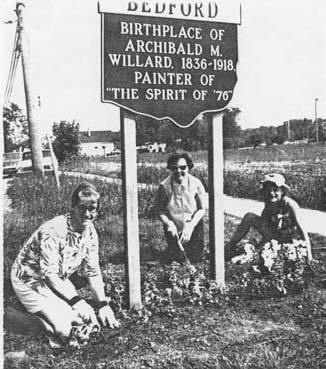
Viola Saunders, Rosemary Wood and Yvonne Saunders beautifying the City’s entrance with petunias in 1970
Another impact of the war years was that paper became scarce, and mailing meeting reminder cards to Club members became a problem. It was decided to post notices in the
newspaper.
In 1970, at the request of City Manager William Schuchart, the Club was asked to join with other organizations in decorating Bedford Square, Broadway Avenue and various locations for the holidays. The Club accepted the challenge. Members gathered materials from fields and gardens. Straw was stripped for a three-foot wreath for the Historical Museum and a two-foot wreath for Bedford Hospital. Pine roping was donated by Mr. Titterington’s Christmas tree farm. This was the forerunner of the City’s holiday lighting on the Square.
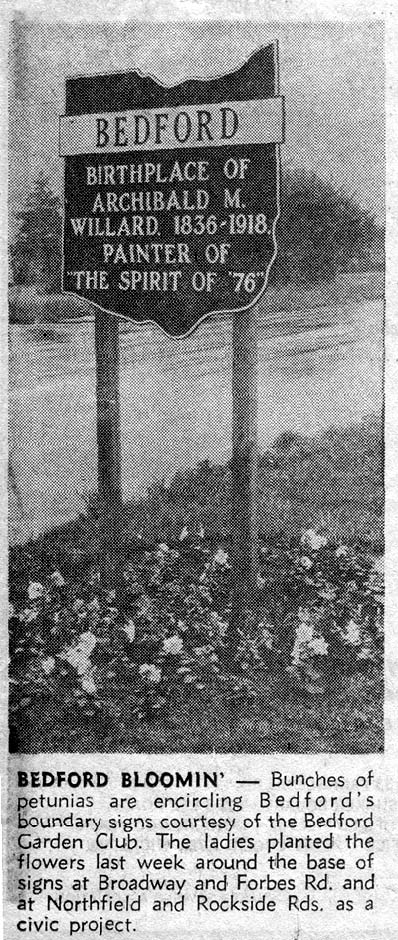
Bedford Bloomin’ – Bunches of petunias are encircling Bedford’s boundary signs courtesy of the Bedford Garden Club. The ladies lanted the flowers last week around the base of the signs at Broadway and Forbes Rd. and at Northfield and Rockside Roads as a civic project.
Other organizations benefited from the Club as well. From the secretary’s minutes we learn members voted to purchase 12-1/2 dozen sets of chinaware as a gift to the new Bedford Library on Center Road. The chinaware was designed by George Rudd and made by the Walker China Company on Solon Road in Bedford. Mr. Viola Saunders, Rosemary Wood and Yvonne Saunders beautify the City’s entrance with petunias in 1970 Rudd, a Bedford resident, had an illustrious career as an artist with Walker China. The Club received a discount for the purchase, $187.60. Carol Ellis, adult services librarian, at the Southeast Branch of the Cuyahoga County Library, reports that a few of the pieces remain. They are a cream color with a turquoise band. A logo of two stacked books with crossed pencils and the letter B, comprise the design.
George Rudd and wife Eva were active members of the Garden Club for many years. George was president in 1959 and 1960. Eva was famous for serving scrumptious cherry tarts when it was her turn for refreshments. We never did get her recipe!
Meals-On-Wheels, the Red Cross (since early war years), the YMCA, Crile Hospital, and Bedford Schools were given financial help. In the late 50’s and 60’s, receptions were held for retiring Bedford School teachers. In 1994, funds were given to Glendale School for a children’s garden. In 2001, a donation of grow-lights added to their learning experiences. The garden remains today and was featured in the 2002 Garden & Artist Tour.
Linda Holmberg climbs the ladder of success for a Williamsburg theme holiday deco-rating project in the Bedford Histroical Society Museum.
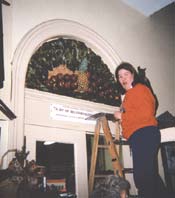
Linda Holmberg climbs the ladder of success for a Williamsburg theme holiday decorating project in the Bedford Historical Society Museum.
Tussie-mussies, created by Viola Saunders and Mary Adams, fill the air with herbal fragrance at the Bedford Historical Society’s Civil War Re-enactment The Club has served the Bedford Historical Society in many ways. Since 1969, Garden Club members have been decorating the Historical Museum, Dunham House and the train depot for Christmas and Spring open houses. The Herb Garden, designed in 1972, leads the list of services. (More on the garden later.) On a cold November day, two hundred red, white, and blue hyacinth bulbs were planted on the Museum grounds for the nation’s Bicentennial in 1976 by Viola Saunders, Walter Robeson, and Barbara McDaniel. The Club worked at beautifying the Museum grounds, making and demonstrating “tussie-mussies” (a tightly gathered, hand-held bouquet of fragrant herbs and flowers) for distribution at the Civil War Days, donating flowers for the Strawberry Festival,and helping whenever needed.
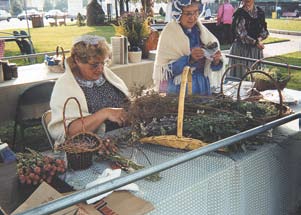
Tussie-mussies, created by Viola Saunders and Mary Adams, fill the air with herbal fragrance at the Bedford Historical Society’s Civil War re-enactment.